
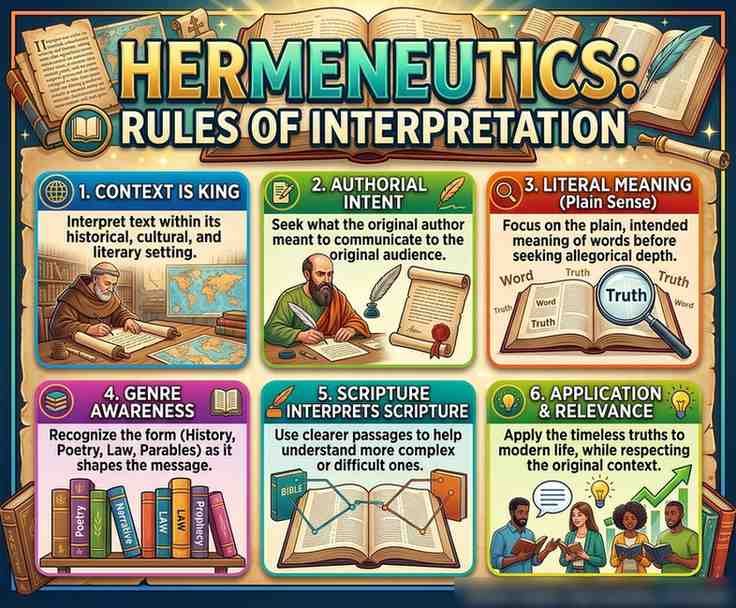
This involves a thorough study of words before arriving at a meaningful interpretation. Because bible writers expressed themselves in words which are the fragments of their thoughts they used familiar words of common usage. They did not coin or formulate new words that their audience did not understand. Therefore while interpreting do not assume or predetermine the meaning but appeal to how the primary audience understood it.
Make use of the Greek and Hebrew lexicon. e. g. Romans 1:1 “Paul a servant of the Lord” Servant in Greek “doubles” meaning-bond slaves.
Phil. 3:20; 1:27 Conversation-Greek “Politeuma” Citizenship Tim. 21: 15 love-Agapao ardently, supremely, perfectly Peter’s answer = Phileo-
- friendship love
- personal attachment
- To be fond of (i. e. Peter said thou knowest that] am fond of you. You know I am your friend
While agape is wider embracing especially the judgment and deliberate assent of the will as a matter of duty and principles ‘Philoe’ is of sentiment and feeling.
Definition is approached in these 3 ways.
- Etymological
- Comparatively
- Culturally.
1. ETYMOLOGY
Studying a word from its root formation e.g
Bishop form – Episcopos Greek
Epi-upon or over
Scopos-to look
Bishop overseer
Apostle-Apo/stello Gr. to send away from Apo-away from Stello-to send.
Disadvantage
One great disadvantage is that the common designation of words change with time. i.e. the meaning of the word at the very initial stage of usage or the formation of he word. Therefore to depend only on the etymological study of the word might lead to a wrong meaning For instance the word:
ENTHUSIASM – originally meant to be “possessed by a god” But it means in our day “ardent eagerness, zeal”
INSPIRE – originally meant to be possessed by a particular Greek god and “speaking out of ecstasy” but now it means “infuse though, feeling into”
2. COMPARATIVE STUDY
Comparing the meaning and use of a word in one passage to the use in another e.g. various uses of “sanctify” save, deliver Matt. 21 1 with Mk. 11 ‘DREWNIGH’ and ‘CAME NIGH’ Mt. 20:21 with Mk. 10:37 ‘KINGDOM’ and ‘GLORY”
The concordance is best to appeal to in this instance.
Advantage:
- It helps not to arrive at meanings prematurely 1.
- It helps to guide against arriving at shallow meaning
Recommended Reading
PRAYER & SPIRITUAL WARFARE: MUST FOR PRAYER PARTNERS
7 Lessons from the Life of Daniel: Excellence in Exile
PRODUCTIVITY: The Master Key of Abundance – New!
3. CULTURAL STUDY
Study the culture attached to words use. expression used in the passage.
Eg:
“Sower” how did they sow?
“Marriage” how did they perform their marriages?
“Greet not how did the people greet then? Is it in the same way with the Western Word
General Guidelines
1. Try to get the meaning or notion of that word according to the understanding of 6. original speakers of the language. Gambians & Sierra Leoneans speaking some Yoruba words & names – Root freed slaves
2. Always attempt to return the common designation of the word except where weighty reasons show it might not be the 2 exact form.
3. Where a word has more than one meaning or signification, employ the meaning that best suits the passage in question. Known character, sentiments and circumstances. e.g.
(a) Jeremiah prophesying toward the Babylonian captivity-zealous for God, burdened for the people, and molested and derided by his g people.
(b) Why so much love in John’s gospel and epistles? Apostle oflove and elderly.
4. Try to draw distinction between apparently synonymous words. See that your distinction conforms with authors sentiment
5. You should note whether the terms or the words used are in a restricted sense or not. e g. behave man for man or woman The weight on “sin” in Ezek. 18:4
6. Endeavour to see that the sense you give to any interpretation does not affirm or deny more than what is said in the original text. Deut. 4:2: Prov. 30:6; Rev. 22: 18,19.
7. Do not conclude upon the sense of a text if weighty reasons show that such meaning is repugnant distasteful to common understanding.
Helpful Books
- Profitable Bible Study-wilbur Smith
- Biblical Theological Lexicon of N. T. Greek -H Cremer
- Strong’s Exhaustive Concordance
- Young’s Analytical Concordance to the Bible
- The International Standard Bible – Encyclopaedia
- The N. T. World H Dong.
- From the Stone Age to Christianity – W. Abright
- A manual of Bible History-W. Blaku
- The Expositors Greek Testament W. Nicoll
- Biblical hermeneutics-Terry M. Iron
- Protestant Biblical Interpretation – Bemand Ramun
- Baker’s Dictionary of Practical Theology-Edited by Tumbull
- The Principles of Biblical Hermeneutics by J. E. an
- Insight Into Bible Times and Customs – by C. G Weiss