
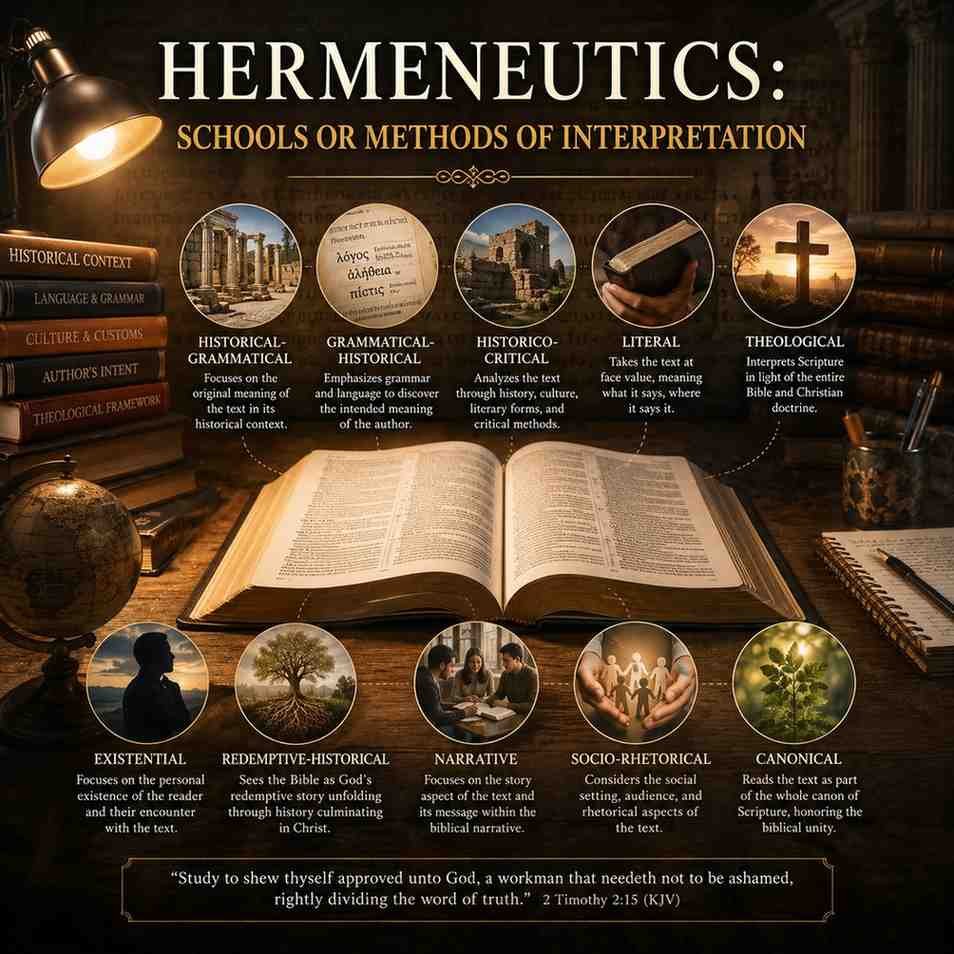
The word of God is not from man; it has no human origin rather it originated from God. When an interpreter approaches the scriptures with the right and proper method is only when we guarantee correct result. There are many propounded methods of interpretation in the hermeneutical balance but two are major under which the larger number of interpreters of the modem day fall.
The two major modern approaches to Bible interpretation are called Allegorical schools or Methods of Interpretation and the Literal School or Method of Interpretation also known as the Grammatico.
A. ALLEGORICAL METHOD OR SCHOOLS OF INTERPRETATION
1. What is an allegory?
Allegory is a symbolic representation, a natural or religious story in which the lesson is the substance and the details are just accessories to the main pint,
- A dictionary says, “Allegory is an extended vi. simile, (A simile is a figure of speech consisting in likening one thing to another).
- Another dictionary explains. “An allegory is a speech or discourse which conveys a meaning different from the literal substance in the speech or discourse e. g the allegory of law and grace in which Sarah, Hagar, Mtt. Sinai in Arabia and Jerusalem are likened to the two covenants Gal 4:25-
- Story in which meaning is different form that which words convey The Pilgrim’s progress is a popular allegory
2. Primary Aim of Allegorism
Theological allegorism is aimed at avoiding difficulties by creating peculiar meanings. The end, the difficulties created are more than those aimed to avoid
3. Origin of Allegorism
Allegorical interpretation started with the Greeks who were not the primary audience or receivers of the oracles of God (the scriptures). Followed by these were the Jews in Alexandria in Egypt called the Alexandria Jews. They too imbibed the method from the Greek originators because of their lack of knowledge.
4. Allegorical Passes in Scripture
- The trees anointing a King (Judges 9:7-
- The whole armour of God (Eph. 6:10-18)
- The Shepherd and David (Ps. 23)
- The Great Eagle of Ezekiel 17: 1-10
- The grape vine-Ps.80:8-14)
- God’s vineyard-(Isa. 5. 1-7)
- The fold and the Shepherd (In. 10)
- The vine, husbandman and branches (Jn. 15:1-7)
- The thistle and cedar (II Kings 14:9)
- Death to the body (Eccl. 12:3-7)
5. Allegorical Method:
An allegory is an expression or explanation of one thing under the image of another. For example when ideas and virtues such as love, truth, patience, purity are symbolized by person who are characters in a story. The method whereby a literary text is interpreted that the literary sense is the vehicle to the secondary spiritual or more profound meaning is allegory.
In this method, not much emphasis is laid on the literary meaning of the scriptures. The grammar or the historical background is not taken into consideration. As such the original words and events are ignore. They claim that there is a second meaning to every text. Things are seen figuratively and not literally.
6. Inconsistencies in the Method:
This method cannot be used in interpreting the scriptures because it departs from realities and attempt to spiritualize everything. As such many of the interpretations will be he interpreter’s own opinions and ideas but not the true sense presented by scriptures.
In this method, the fact that scripture interpreter scriptures is not followed. Since the legitimate meaning of the author’s language is rejected the scripture, itself is not regarded as the basic authority in interpretation. Therefore, this method of interpretation cannot be tested through available means of evaluation.
Notes: This does not rule out the fact that there are allegories, such as types, symbols or parables. There are many O. T. types fulfilled in the New Testament. That is the anti type now found in the New testament. However, that there are types does not support the allegorical method.
Generally, what is involved in the types is that truths in the scriptural realm are conveyed in realm that is familiar. That there could be a transference of thought, what is true in one realm can or should be true in the other. There should be a literal parallelism between a type and the anti-type
7. Defects of Allegorical Method
There is a difference between interpreting an allegory and allegorizing Plain scriptures. The following defects can therefore be pointed out from allegorizing or the allegorical methods of interpretation:
- It does not give consideration to historical interpretations
- It is always aimed at avoiding peculiar theological difficulties or creating religious impressions; thus, they pervert the common signification of Words.
- It allows interpreters to move to unlimited scope which cannot be tested
- It takes away the authority of scriptures
- It does not give emphasis to the literal meaning of words ad statements.
- All words and statements are said to have a secondary spiritual and deeper meaning.
- They do not consider valuable aids to interpretation like archaology, geography, etymology root meaning etc.
- They interpret according to their whims and caprices to suit their own minds.
- They deny the verbal inspiration and authority of scriptures, not believing that scripture interprets scripture. They believe that every statement is unique distinct and different in meaning to the other.
- Since they do not follow BASIC RULES of interpretation, their works cannot be tested or controlled.
2. THE LITERAL METHOD:
The literal methods of interpretation is the approach in which every word, statement or clause is given the same, exact basic meaning il would have in normal, ordinary, day to day. customary, usage whether employed in writing. speaking or thinking.
The method empathizes ie puts present passage being considered-how they understood audience in the position of the primary audience of and responded to it.
In this method, meanings are determined by giving both the grammatical and historical settings due consideration. The method is also called the Grammatioco-Historical method.
The literal meaning of a Word is the basic customary, social designation of that Word. When one interprets literally he does not add or take away anything from the word, or passage being Interpreted. The interpreter allows the word to be interpreted on its face value, as it is used in normal, usual occurrences.
Recommended Reading
PRAYER & SPIRITUAL WARFARE: THE EFFECTIVE PRAYER WARRIOR
FLOURISHING MINISTERS, FLOURISHING MINISTRY: LIFTING UP THE STANDARD
The Great Commission: Our Responsibility to Reach the Lost
9 Mistakes Singles and Newly-Weds Need To Avoid
1. Advantages of Liberal Method:
- In this method, interpretation is approached objectively, being factual and national thus taking into consideration grammar, logic, history, etymology. geography, archaeology, theology and all other relevant factors
- This method can be tested and controlled.
- It rejects whatever goes against the norms of interpretation. It has been the most successful reliable methods of Biblical Interpretation. Most of the highly respected scholars after the reformation used it.
- It gives room to rationalistic approach and conformity to predetermined theological system to prevail rather than following reason and mysticism as the basis of interpretation.
- This is the method that enhances and works in support of the Plenary Inspiration O the Scriptures. In this one realizes that the Holy Spint guided men into truth and away from error In this process the Holy Spirit of God used language. The units of language are words and thoughts. This form of interpretation gives serious consideration to grammar and words which are the two fundamentals of all meaningful speed.
- Also, this method does not blindly rule out figures of speech, symbols, allegories and types. It only serves as the basis for which their secondary meanings can be adequately interpreted.
Notes: From a good study of the scriptures this had been the method used.
Students of Hermeneutics claim that Biblical or Sacred hermeneutics started after the turn of the children of Israel from exile. The word of God has become unintelligible to them because, they had replaced their native tongue with Aramaic while in exile
Ezra, regarded as the first interpreter-N eh. 8: 1-8, used the Literal Method. At the time of Christ it was Literal Methods that was used by either the Pharisees, Sanhedrin, Christ and the Apostles they all referred to the Old Testament Scriptures as they were without spiritualizing it.
- It can be tested to prove or disprove.
- It has an objective approach towards interpretation because it puta into consideration, grammar, etymology. archaeology history, theology. This is why it always arrive at factual and logical conclusions.
- It rejects anything that goes against normal principles of interpretation.
- It has been the most successful and most reliable method of interpretation.
- It has been used by most of highly respected scholars of the Bible especially since after the Reformation because the reformers make use of this method of literal interpretation
- It believes in literal Parallelism between types and their anti-types. i.e. what is true for the type which is physical should also be true to it spiritual anti-types. For example:
# The Brazen Serpent raised on a tree type of Jesus raised up on the Cross
# Anyone who looked up on the serpent lived as whosoever looketh on Jesus shall be saved -Num. 21-8 with in. 3:14
2. Origin of Liberal Method
Literal method of interpretation dates back to the Bible. The first notable interpreter of the Bible had been Ezra Neh. 8: 108. In his interpretation he only explained the words as they were. This same method was what all the Apostles, the Lord Jesus Christ used whenever they appealed to scriptures.
3. Statements of Prominent Bible Scholars in Support of Literal Method of Interpretation.
Martin Luther
Every word should be allowed to stand in its natural meaning and that should not be abandoned unless faith forces us to it. it is the attribute of Holy Scriptures that it interprets itself by passages and places which belong together and can be understood by the rule of faith.
Tyndale Said:
“Thou shall understand, therefore that scriptures hath but one sense which is the literal sense. And that the literal sense is the root and ground of all and the anchor that never faileth whereunto if thou cleave than canst never err or go out of the way. And if thou leave the literal sense thou canst not but go out of the way. Never the later, the scripture useth proverbs, similitudes, riddles or allegories as other speeches do; but that which the proverbs, similitudes, riddle or allegory signified is over the literal sense which thou must seek out diligently.
Horatius Bonnar Said:
I feel a greater certainty as to the literal interpretation of the whole word of God. historical, doctrinal, prophetical. “Literal if possible” is, I believe, the only maxim that will carry you right through the Word of God from Genesis to Revelation
The Bible authors like all sensible writers wished to convey to their readers one definite thought in words which they could understand. A passage may have a literal or a figurative sense, but cannot have two senses at once. The word of God is inexhaustible and applicable to all times but there is a difference between explanation/interpretation and application. And application must be consistent with explanation. All these statements are to direct you to arriving at correct and right results.
The Bible must be rigidly explained according to its own language ad in this explanation. It must neither be bribed by any external authority of the church nor by our own feeling nor by a sportive and allegoring fancy which had frequently been the case with the mystics, nor finally by and philosophical system whatever “While interpreting disabuse your mind of all possible influences.