
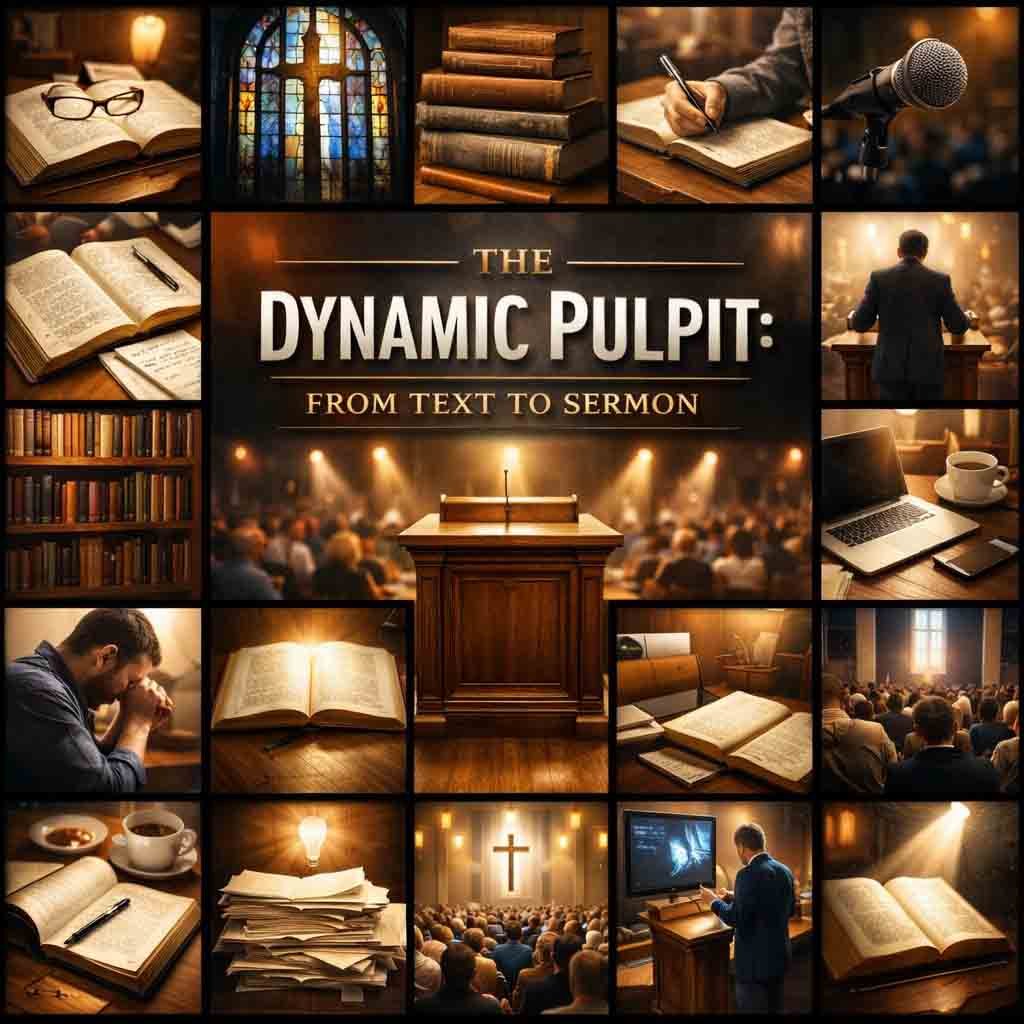
Goal for this lesson: To See How We Progress from Words on a Page in a Passage of Scripture to a Sermon that is designed to Change Hearts?
Introduction: Six Critical Questions for Sermon Preparation:
I. What Does this Text Mean?
To answer employ these steps:
A. Read re-read and digests the text.
B. Phrase, history, and genre) Observe context (look at literary word.
C. Look up the unknown.
D. Identify Parallels.
E. Grasp the main Idea.
F. Tentatively conclude what the text is basically about.
II. How Do I Know What It Means?
To answer re-create on paper the mental process by which the earlier conclusion was reached and examine its accuracy:
A. Create a “Thought-flow Outline” (one or more of 3 basic alternatives):
- Grammatical Outline: Identify the verb etc.
- Mechanical Layout: Determine independent clause and the dependent clauses
- Conceptual Outline: Walk down the text and outline the text and write in a sentence of what it means to you. Comments and observations may also be listed to the side of each of these outlines as your study proceeds.
- The larger the “expository unit” the more appropriate the latter alternatives for outlining listed above. In creating such “outlines for study of a passage” which are known as “Exegetical Outlines” it is advisable to identify which verses correspond to which outline components by incorporating verse numbers into the outline.
B. Use the development of the “Thought-flow Outline” to lead you into and through an in- depth study of:
- Language (Greek, Hebrew)
- Genre (Poetry, Historical narrative, prophecies)
- Context (Involves four things; Observation, comparison, word study, context study)
III. What Concerns Caused This Text to Be Written?
A. To answer requires study of:
- Study authors intention. (Why did Paul writes the text to them? e.g. I Cor.13)
- The passages context. (What was going on then, what situation arises then?)
- God’s mind. (What concern causes the text to be written?)
To this point you have only a lecture. From this point a lecture becomes a sermon:
IV. What Do We Share in Common with?
- Those Whom the Text Was Written.
- Those (the one) whom the Text Was Written.
Biblical teaching does not primarily point to others it also applies to … “No temptation has overtaken you except such as is common to man; but God is faithful, who will not allow you to be tempted beyond what you are able, but with the temptation will also make the way of escape, that you may be able to bear it. (I Corinthians 10:13-NKJV).
Good preaching does not merely contain the information in a text (or the truths about a doctrine), it is how an F.C.F. of the passage touches and characterizes our lives.
Recommended Reading
EVANGELISM: THE BIBLICAL BASIS
10 Ways to Study God’s Word Daily
10 Guidelines That will Keep You In Minsrtry
V. How Should We Respond to the Truths of Scripture?
(What Difference does it make for me?) Nathan’s account of rich man stealing lamb. (II Sam 12:7)
Behold the lilies of the field. They toil not neither do they spin. Yet evens Solomon in all his glory was not arrayed like one of these. If God so clothes the grass of the field which today is and tomorrow is cast into the fire, will he not much more clothe you? (Matthew 6:28-30)
Good Sermons Always Answer these Questions:
- What concerns caused this text to be written?
- What do we share in common with those whom the text was written and those who wrote the text?
- How should I respond to the truth of the scripture?
VI. What is the Most Effective Way I Can Communicate the Content and Application of the Text?
To answer we must:
A. Use Organizational Tools:
- Collection:
- Subordination:
- Simplification:
B. There are four things that can be done to explain any text or idea:
- Read the text.
- Look for key word, place or person.
- Check and look for similar references for words, phrase, contents or context.
- Ask the critical questions about the intent of the author.